

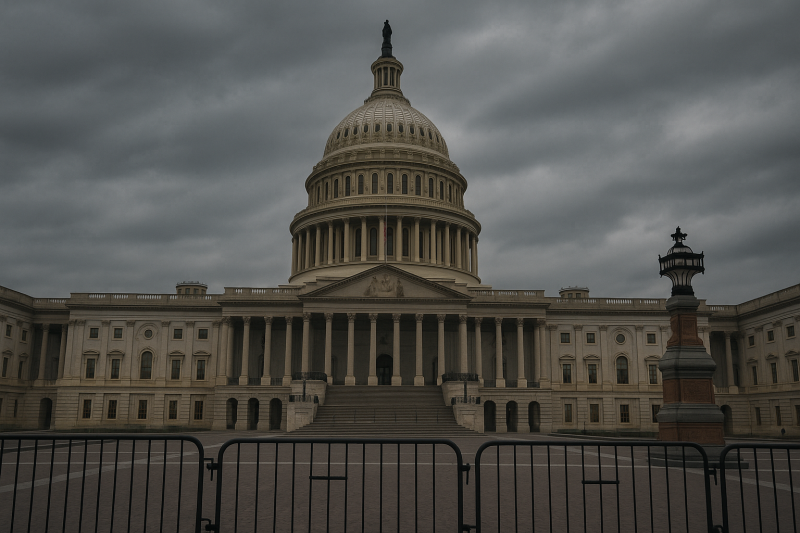
Let’s be honest for a moment — Washington isn’t shut down. The government is. The politicians? They’re still on camera, still fundraising, and still tweeting their talking points while the American people — the ones who actually make this country run — are the ones paying the price.
Once again, we find ourselves watching the same tired movie: Congress lurches toward a government shutdown, both parties dig in their heels, and instead of leadership, we get political theater. The difference this time? Americans are less entertained and more exhausted. Because behind all the headlines, it’s not politicians feeling the pain. It’s military families missing paychecks, air traffic controllers pulling double shifts without compensation, small businesses losing contracts, and everyday citizens wondering what exactly we’re paying for when the people in charge can’t even keep the lights on.
This isn’t governing. It’s political chicken with 330 million people caught in the middle.
The Blame Game Nobody Wins
If you turn on cable news right now, you’ll hear two very different stories. Democrats are saying the shutdown is because Republicans can’t pass a “clean” continuing resolution — the stopgap funding bill that keeps the government operating. Republicans say Democrats are holding the country hostage over bloated social spending and weaponized agencies. And both sides will tell you, with a straight face, that it’s the other party’s fault.
But here’s the truth: they’re both right — and they’re both wrong.
Because while they argue over who’s responsible for the mess, not one of them is acknowledging the obvious — the entire system is broken. The federal government is so bloated, so overextended, and so dependent on short-term political fixes that every few months, we’re playing the same game. Washington runs out of money, Congress refuses to pass a real budget, and we all brace for impact.
This isn’t new. Since 1976, the federal government has shut down 21 times — most recently in 2018–2019, when a standoff over border wall funding left 800,000 federal workers without pay for 35 days. It was the longest shutdown in U.S. history. Today’s shutdown threat feels eerily similar: two parties, one bloated budget, and zero accountability.
The irony? Both sides claim to “stand for the people,” yet when the checks stop coming, it’s the people who suffer — not the politicians.
The Real People Paying the Price
When Washington shuts down, the headlines focus on “nonessential services,” as if those are things nobody needs. But “nonessential” doesn’t mean “unimportant.” Ask the small business owner waiting on a federal contract payment. Ask the veteran who can’t get an appointment at the VA. Ask the TSA agent or the air traffic controller who’s still expected to show up for work without pay.
Here’s what “nonessential” really means during a shutdown:
- Over 1.3 million active-duty military members and their families often go without pay, even while serving abroad.
- Air traffic controllers, who already face burnout and staffing shortages, are forced to work without pay — putting strain on an industry that’s critical to public safety.
- Small businesses that rely on federal contracts or SBA loans lose cash flow, which can mean layoffs or closures.
- National parks close or operate without staff, devastating local economies that depend on tourism.
- SNAP benefits, WIC, and other programs that millions rely on for food assistance begin running on fumes after a few weeks.
- And yes — federal employees go without pay while members of Congress continue collecting their checks.
This is what happens when governance becomes gridlock. Washington elites argue about “pork” and “policy riders,” while Americans are left wondering if they’ll be able to afford groceries, medicine, or their next mortgage payment.
“Clean” Bills and Dirty Secrets
Let’s talk about that so-called “clean” continuing resolution. Both parties love to throw around the word “clean” — it sounds good. It sounds responsible. But let’s not kid ourselves.
There’s no such thing as a truly clean CR anymore. The Republican-backed proposal floating through Congress right now? It’s not “clean.” Sure, it trims some spending here and there and puts a temporary lid on certain agencies, but it’s also stuffed with pork — special carve-outs, pet projects, and political favors that have nothing to do with keeping the lights on. The Democrats’ version? No better. It includes massive increases to discretionary spending, billions in climate subsidies, and bureaucratic expansions that have no business being in a short-term budget bill.
This is the problem with Washington in 2025: everyone’s so used to hiding their wish lists inside “must-pass” bills that no one even pretends to be transparent anymore. The continuing resolution process — designed to prevent shutdowns — has become a way to avoid accountability altogether.
Instead of doing their job — passing a real budget, line by line, department by department — Congress punts the ball downfield with a patchwork CR and hopes no one looks too closely at what’s inside.
The ACA Tax Credits and the Illusion of “Cuts”
Now let’s address one of the big sticking points: the Affordable Care Act (ACA) tax credits.
Republicans want them gone. Democrats want them expanded. But as usual, the truth lies somewhere between the talking points.
There’s no doubt the ACA subsidies have ballooned federal spending. According to the Congressional Budget Office, ACA premium tax credits cost $90 billion in 2024, projected to exceed $100 billion annually by 2026 if left unchecked. That’s unsustainable. But cutting them off overnight isn’t the answer either.
Phasing them out responsibly — over time — is the only fiscally and morally sound path forward. Millions of Americans depend on those subsidies for their health coverage, and abrupt elimination would create chaos in the insurance market and leave vulnerable families without care.
That’s the kind of pragmatic approach Washington should be taking — not political posturing. But let’s face it, nuance doesn’t win cable news segments or campaign donations. Soundbites do.
The Political Chicken Match
So here we are. Republicans say they’ll only fund the government if Democrats agree to “real spending cuts.” Democrats say they’ll only negotiate if Republicans drop their “extreme” demands. Both accuse the other of playing politics while doing the exact same thing themselves.
If you look closely, the shutdown isn’t about money — it’s about control.
Each side wants to frame the narrative heading into election season. Democrats want to paint Republicans as reckless and anti-worker. Republicans want to paint Democrats as big spenders and fiscally irresponsible. And while they posture for cameras, the rest of us are stuck in the middle of their messaging war.
The numbers are staggering. The national debt has soared past $35 trillion, with annual interest payments now larger than the entire defense budget of most nations. Yet Congress still refuses to make real reforms. They’d rather fight over crumbs while the loaf burns.
This isn’t a budget debate anymore. It’s a game — and we’re the collateral damage.
Voices of Reason (Yes, They Exist)
Not everyone in Washington is playing along, though. A handful of voices are still speaking common sense — and they deserve credit for it.
Senator Rand Paul has been a consistent voice for fiscal sanity, arguing that the only way to stop these crises is to stop spending money we don’t have. He’s right. Paul has called for real budget reform, single-subject bills, and an end to the omnibus insanity that lets Congress cram everything from border security to foreign aid into one unreadable monstrosity.
Representative Thomas Massie has echoed that sentiment, calling out both parties for their addiction to debt. He’s one of the few lawmakers willing to point out that every CR is just a temporary patch on a permanent wound — and that if Congress actually followed its own rules, these shutdowns wouldn’t even happen.
And then there’s Representative Marjorie Taylor Greene — a name that surprises some people in this conversation. But credit where it’s due: Greene has been one of the few Republicans publicly demanding transparency about where taxpayer dollars are going, particularly when it comes to foreign aid and bloated defense spending. Whether you agree with her style or not, the substance of her critique hits a nerve: Why are we funding the world when we can’t even fund ourselves responsibly?
These voices — Paul, Massie, Greene — may not agree on everything, but they’re doing something rare in Washington: asking real questions and demanding real accountability.
The Bigger Picture: Dependency and the Expanding State
Here’s the uncomfortable truth that no one in Washington wants to admit: the very fact that a government shutdown causes nationwide panic is a symptom of the real disease — a federal government that has grown far beyond its proper role.
Think about it. The moment the federal government “shuts down,” the stock market wobbles, people panic about losing healthcare or benefits, and agencies grind to a halt. That’s not normal. That’s not freedom. That’s dependence.
When did we become a nation so reliant on Washington that a temporary budget fight can threaten food security, small business operations, and even air travel?
It wasn’t always this way. For most of American history, the federal government had a narrow focus: protect rights, defend the nation, regulate trade, and leave the rest to the states and the people. Local communities thrived because they weren’t waiting for Washington to fix their problems. Today, the federal government is the largest employer in the country, with over 2 million civilian workers, not counting the military or contractors. Entire industries are now tethered to federal dollars.
The shutdown panic is just a symptom of that overreach. When the state becomes the source of everything — jobs, healthcare, housing, education — the people become subjects of dependency, not citizens of liberty.
The Forgotten Concept: Fiscal Responsibility
In 2000, the federal debt was $5.6 trillion. Today it’s over $35 trillion — an increase of more than 500% in just two decades. The interest alone will surpass $1 trillion annually by 2026, according to the CBO. That’s money we’re spending not on infrastructure, defense, or healthcare, but on interest — payments to service the debt from decades of reckless spending.
And what does Congress do? They raise the debt ceiling, pat themselves on the back, and call it “saving the economy.” It’s like celebrating because you got approved for another credit card after maxing out the first five.
No household, no business, no local government could operate this way. But Washington can — because Washington makes the rules.
What We Desperately Need: Real Reform, Real Conversations
So what’s the solution? It’s not another CR. It’s not another blame game. It’s returning to the basics — to governing like adults.
Congress needs to:
- Pass single-subject appropriation bills. Stop hiding spending in 2,000-page omnibus monstrosities that no one reads.
- Phase out unsustainable programs — like the ACA tax credits — responsibly, while investing in community-based solutions and state innovation.
- Reinstate fiscal caps tied to inflation and population growth, so government can’t expand faster than the economy.
- Eliminate automatic pay for Congress during shutdowns. If federal workers don’t get paid, neither should their bosses.
- Rebuild local resilience — encourage states and communities to take back functions that never should’ve been federal in the first place.
These aren’t partisan ideas. They’re common sense.
But common sense doesn’t trend on social media. Outrage does. And as long as outrage pays better than honesty, the dysfunction will continue.
The Hypocrisy of Modern Politics
Every election cycle, both parties campaign on “draining the swamp.” Yet the swamp keeps getting deeper — because they’ve both learned how to swim in it.
Democrats talk about “the people” while expanding bureaucracies that crush small business and innovation. Republicans talk about “limited government” while quietly approving massive spending bills filled with defense contracts, subsidies, and special-interest perks. Then they both go on TV to tell you the other side is the problem.
But the American people are catching on. They see through the performative fights and the photo ops. They know the truth: Washington doesn’t have a spending problem alone — it has a priorities problem.
The Founders didn’t envision a government that shut down every time politicians wanted to score political points. They envisioned one that worked for the people, not for parties.
It’s Time for a New Motto
Maybe it’s time we retire the slogans. “Make America Great Again” has been politicized to death. “Build Back Better” never materialized. What we need now isn’t another bumper sticker — it’s a wake-up call.
How about:
Put the American People First Again.
Or better yet, Make America Constitutional Again.
Maybe even, Make America a Free Nation Again.
Because at the end of the day, freedom isn’t measured by how big your government is — it’s measured by how little you need it to live your life.
When a government shutdown can freeze paychecks, ground planes, and threaten basic needs, that’s not freedom. That’s control. That’s dependency disguised as compassion.
The path back isn’t easy, but it’s simple: demand accountability, reject partisanship, and remember that no matter how loud Washington gets, the real power still lies with we the people.
Closing Thoughts: The Republic Still Belongs to Us
Every time the government shuts down, we hear warnings about chaos, about what happens if Washington stops working. Maybe the better question is — what happens if it keeps working like this?
If this shutdown teaches us anything, it’s that America has lost its balance. We’ve let a bloated bureaucracy and a self-interested political class convince us that they’re indispensable. But they’re not. The founders designed a government of limited power for a reason — because they understood human nature, and they knew what happens when politicians forget who they serve.
So yes, the shutdown will end — they always do. The CR will pass, both sides will claim victory, and nothing will change. Until we demand that it does.
It’s time Congress stopped acting like a dysfunctional family fighting over the last slice of pizza and started acting like representatives of the people again. Not the lobbyists. Not the donors. Not the party leaders — the people.
Because the Republic — for now — still belongs to us.
But only if we’re willing to take it back.
Add comment
Comments